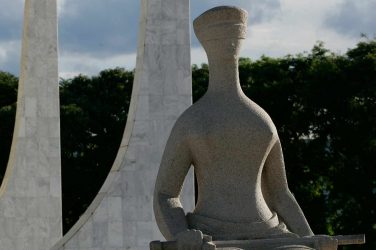


Somewhere between outraged and perplexed, Brazilians have been bombarded with news about their political underworld, covering everything from graft scandals and political intrigues to, on June 10, a narrow Supreme Court vote to save Michel Temer’s presidency.
Recently, the Brazilian version of the Netflix series House of Cards even tweeted that it’s “hard to compete” with the country’s realpolitik.
But rampant public corruption is not the only threat to Brazil’s democracy. It’s not even the most dangerous one.
Brazil is one of the world’s murder capitals, with 60,000 homicides every year in a population of almost 208 million. Fully 10% of all people killed globally each year are Brazilians.
As demonstrated during recent bloody prison uprisings and police strikes in Espírito Santo and Rio de Janeiro states, the authorities seem incapable of dealing with the problem.
There have been some successful public safety initiatives over the past decade. Police reforms and anti-violence initiatives in Rio de Janeiro and Pernambuco managed to reduce homicide rates by up to 50%, but only temporarily. In these places, too, murder is on the rise.
Almost 50 million Brazilians aged 16 or older – nearly a third of the adult population – know someone who has been murdered, according to research conducted for Instinto de Vida (Life Instinct), an Open Society Foundations-funded campaign shedding light on Latin America’s homicide problem.
Almost 5 million have been injured by firearms and some 15 million know someone who was killed by the police, one of the world’s deadliest forces.
In Rio de Janeiro’s poor favelas, frequent military-style police operations and extrajudicial police killings of alleged gang members are common. Locals live in daily panic.
The social hysteria caused by Brazil’s homicide crisis, combined with growing disillusionment with politics, is giving rise a markedly undemocratic strain of politics.
Today, public officials regularly invoke sexist, racist and xenophobic discourses to justify punitive policies that criminalize huge swaths of society, from gang members to drug users and ethnic minorities.
Like Donald Trump, France’s Marine Le Pen and Holland’s Geert Wilders, who all use the threat of terrorism to stoke fear and intolerance, Brazilian leaders, too, have determined that imposing order is more important than building a stronger society. Only here, fear is fueled by unceasing violence and the clear incapacity of public security institutions to address the problem.
According to a survey by the Getúlio Vargas Foundation, 36% of the Brazilian population feels satisfied with the police; only 25% say they trust them. This distrust exacerbates perceptions of danger.
Authoritarian Personality
At this juncture, Brazilians might seek out leaders who reject violence and impunity. Instead, they seem inclined to dismantle the post-dictatorship-era rule of law heralded by the 1988 Constitution, signed after democracy was restored.
According to unpublished national survey by the NGO Brazilian Forum on Public Safety, which interviewed 2,087 people across the nation, 69% of Brazilians aged 16 or older agree that “what this country needs, above all, before laws or political plans, is some brave leaders, tireless and dedicated in whom the people can deposit their faith”.
Fans of German philosophy may recognize that sentence; it’s a translation of a question from Theodor Adorno’s 1950 classic study on the authoritarian personality. In it, Adorno sought to understand how Nazism had attracted so many Germans in the early 20th century, concluding that periods of crisis are fertile for the advance of authoritarianism.
Looking at Adorno’s study alongside the Brazilian Forum’s results makes for dire forecasts about Brazil’s democratic future.
The national desire for authoritarian leadership is personified by Jair Bolsonaro, a former army captain from Rio de Janeiro state who is expected to run for president in 2018.
Bolsonaro, who openly calls for a return to military rule in Brazil, draws large crowds to gymnasiums and schools across the country with speeches that denounce the “human rights agenda”. He has 4.35 million Facebook followers.
Police officers – the same force that, in theory, should be guardians of the law – are quite taken with him. For cops, who confront Brazil’s dangerously out-of-hand criminality every day, it seems becoming hardline on law and order is starting to sound pretty good.
A Corrosive Process
Perhaps unsurprisingly for a country where evangelical Christianity is exploding in popularity, the study found that 64% of respondents also believe that “we should all have absolute faith in a supernatural power, whose decisions we must abide by.”
As religiosity infiltrates Brazil’s politics, faith is becoming something of a new order, creating a complex symbiosis between state and religion that organically influences public opinion and policy-making.
When people believe that “the policeman is a warrior of God who must impose order and protect the good people” – an opinion held by 53% of Brazilians – it justifies two damaging behaviors.
First, it condones widespread police brutality, and, second it allows for tolerance of local rule by criminal organizations (because if you can overpower the agents of God, then you can definitely impose your will on the population).
Infusing public order with private morality to justify authoritarianism is both more subtle and powerful than the more classic nostalgia for military rule when times get tough.
Brazilians fought hard to regain civil and human rights after two decades of a bloody military dictatorship. Now, 30 years later, paralyzed by crime and violence, they’re again flirting with authoritarianism and intolerance.
In this corrosive process, organized crime has doubled down, corruption has multiplied, and instability and danger have warped the nation’s politics. To save its democracy, Brazil urgently needs to find a new solution for public safety. Otherwise, fear, crime and homicide will win.
Renato Sérgio de Lima is a professor and researcher at Center for Applied Legal Research, Brazilian School of Public and Business Administration (EBAPE/FGV)
This article was co-authored by Samira Bueno, PhD candidate at the Getúlio Vargas Foundation and executive director of the Brazilian Forum on Public Safety.
This article was originally published in The Conversation. Read the original article here: http://theconversation.com/brazils-biggest-problem-isnt-corruption-its-murder-78014